I grew up around horses and know which end the bit goes, but as they were all trotters, I’m not qualified to say much more than “here are some saddles”. I’ll be using proper names, so if you aren’t familiar with them, you may want to do a search on “saddle anatomy” or the problem words. Beware, the photos aren’t in chronological order of period, I’ve gone from simplest to most complex. As usual, clicking on the photos with enequinate and take you to larger views.
So, here are some saddles.
This first one is a late 17th century dragoon saddle from northern Europe in the Tower Armouries. The ascension number is VI.392 if you want to follow up with them.

There are two ‘D’-rings at the front for attaching holsters and two rings at the back for a rolled cloak or valise.
Close up of the pommel, showing the stitching and some hint of the construction. Orientation is the same as in the wide shot of this saddle. The pistol holster attaches to the ring in the lower left of the photo.

View from slightly above, showing seat shape and seam and the method of attaching the rings. The horn is brass.
Lower side view, still from the on side. The padding and skirt stitching can be clearly seen.

Front view showing the horn, pommel and both d-rings. That’s a buff coat cuff intruding in the top left of the frame.

Rear view, showing the padding and crupper ring.

Three-quarter rear view showing stitching. The shape of the tree can roughly be inferred from the shape of the padding.
The second saddle is an English dragoon’s saddle from the mid 17th century, now in the Royal Armouries in Leeds. The main differences to the one above is the presence of the cantle and lack of a horn.

You can see a small fender hanging down from under the skirt. The attachment points for the pistol holsters can be seen at the front.

Front view, the pistols are in the correct location, but the holsters are missing.

Three-quarter view from the front, off side.

Details of the embossing on the seat jockey. This is the off side.
Third is an harquebussier’s saddle again in the Leeds Armouries. It’s contemporary with the one above and is also missing the pistol holsters.

Off-side view. Materials are velvet, metallic silver braid and gilt brass nails over leather and wood.

Front view, showing a small (once) silver-gilt brass horn, and the location of the pistols.
The last one’s pretty top-shelf. It dates from the middle of the seventeenth century and was made for a member of the Hildyard family of Flintham, Nottinghamshire. It’s now in the Nottingham Castle Museum and Art Gallery, where it blurs the distinction between both.

Materials are velvet, metallic silver braid, metallic silver thread, silk and gilt brass nails over leather and wood. And more silver braid. For a change, the pistol holsters are present, and made from all of the above with silver-gilt brass caps and more braid.

The pistol holsters, opus Anglicanum embroidery and the tack.

Holster, off-side. Wow. Just wow.

Detail of the braid towards the back of the seat.

Even closer detail of the intersection of the back of the seat and the skirt. Excuse the low light.
This post is from the internationalroutier.wordpress.com blog, published on September 10,2010.
In some way, Helmut is the genesis of this post. I’d done a post on the ceramic Salisbury Leather Jug and within a few days Helmut had posted some photos of the original the pottery one was copied from. I located the museum website, had a look around at the rest of the site and found this shoehorn.

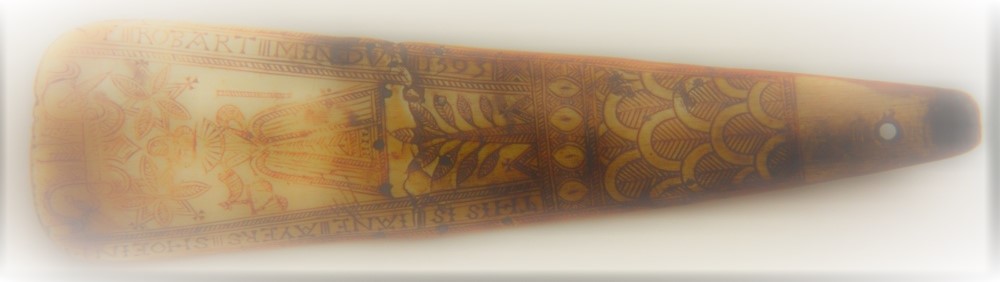
The museum placard reads “Shoehorn 1593 – Shoehorn engraved and inscribed by Robert Mindun in 1593 depicting a figure in Elizabethan costume, perhaps Jane Ayers the lady named in the inscription. Mindun is the earliest recorded English engraver of horn.”
The extant inscription is: THIS IS IANE AYRES SHOEING … ROBART MINDVM 1593. The top of the horn is missing, I imagine it was originally similar to the complete one in the photo below below. It was made by Mindum in 1612 and recently sold for £8,800.

ROBART MINDVM MADE THIS SHOOING HORNE FOR MISTRIS BLAKE ANNO DOMINI 1612 height 9in (225mm)
Shoehorns go back a long way. They hold the shoe open and allow enable the foot to slide in without crushing the shoe’s counter or splitting the back seam of the shoe. While they were made from a variety of materials, cow horn is an ideal medium as the desired complex curves, smooth surface and size occur naturally in the material.
Secrets from the Curator’s Closet has an article about one in their collection, with some information on how the horn was prepared, and some background on Mindum’s work methods. I’ve written to the author and asked for clarification on a couple of points, as the preparation information seems to be for making lanthorn panes and spoons rather that shoehorns, the production times appear to be excessive, and the assertion that Mindum only produced one per year is contradicted by two shoehorns made by Mindum both dated 1593.

ROBART MINDVM MADE THIS SHOOING HORNE FOR JANE HIS WIFE ANNO DOMINI 1613
(Photograph from Secrets from the Curator’s Closet copyright © Bruce Parker, 2010)
The Salisbury and South Wiltshire Musuem claims Mindum is the earliest recorded English engraver of horn. Mindum has left more than his fair share of items for us, indicating that he was either particularly prolific or his work was particularly well regarded and preserved. We really don’t have many plain ones so we can’t even get an idea of the proportion of plain to decorated ones. The proceedings for the Society of Antiquaries on November 24, (The Antiquary, Volume 27, 1893, p41) record that “Mr. Hartshorne exhibited a shoe-horn carved by Robert Mindum, dated 1598, … ; Sir J. Evans exhibited a powder horn and two shoe-horns, also carved by Robert Mindum”. I can’t say that I’ve found any earlier by anyone else but I also can’t say I’ve looked particularly hard.
The Exhibition of the Royal House of Tudor in Repent Street, London(?) in 1890 featured items: 981i ENGRAVED SHOE HORN, 1600 and ENGRAVED POWDER HORN, 1601 by Robert Mindum. Both items were lent by JOHN EVANS, ESQ., P.S.A. I would presume that these are the same J Evans and the same items, giving a date of 1600 for the one displayed to the Society of Antiquaries.
This last one creates a number of problems for those other authorities – made in 1593, it means that he made two that year. The name on it is Hamlet Radesdale Settson, male when all the others are made for women and some sites claim that they were only made for Mindum’s favourites, and Settson’s profession and location are mentioned, to me making it look for all the world like a seventeenth century version of those etched glass or embossed leather coasters or flash pens handed out by software companies that are of not insignificant value but are meant to get their name in front of you every day. This image is from London – A Concise History by Geoffrey Trease, Thames & Hudson 1975.

THIS IS HAMLET RADESDALE SETTSON THE COVPAR OF LONDAN ANNO DOMINI 1593
This one was submitted to the Editor General on 2 July, 2007 and was printed in the subsequent edition of The International Routier, back in it’s dead-treeware days. Vanity presses me to reproduce it here.
At the start of chapter 3 of the forthcoming second edition of the Routier Gaming Manual, I pontificate:
There are no references to dominos in western sources before the middle of the 18th century, when domino games appear to have been played in Italy and France. They are kept in this volume mainly so the Routiers have something to do with their dominoes.
And fair enough too, this is the view held by most serious scholars of the introduction of different games into Western Europe. Strutt (1801) says, “Domino… a very childish sport imported from France a few years back”. My innocent enough enquiry to the Mary Rose Trust in 1996 about the photo above, simply captioned Domino found on the Mary Rose, resulted in the photo being taken down from the site and a personal apology to me from one of the senior archaeologists.

Early 18th century bone domino found in The Solent, allegedly lost from a French prison hulk… or is it?
Photo from the Mary Rose Trust
I scored some really nice archaeological drawings of combs, arrow spacers and book covers for my efforts. In 2003, I also queried a domino on display in the Southampton Archaeological Museum labelled as 17th century, pointing out their own database showed it as probably 18th century. Here I must admit to being a serial offender. I do have a nice letter from Warwick Castle thanking me for the information I sent them challenging their dating of a leather jack on stylistic grounds.
The Southampton domino in question. It’s 14mm wide and 23mm long so almost exactly the same size as the Mary Rose find.
Photo (and attitude) by me.
There’s only one problem… I just got my copy of the Mary Rose personal effects book and now I have to rewrite the intro. They obviously prepared for people like me, the drawing of artefact 79A0665, Single Bone Domino, (complete, 25.8 x 13.3mm) comes with the accompanying text: “… was found in an insecure context on the Upper deck area… It is likely, given the provenance of the object, that the single Mary Rose domino post-dates the wreck.”
So, having safely covered themselves against future emails, they fire a full broadside. “However, dominos from such earlier contexts are attested, though rare. One such with a drilled number was found in Oxford and was thought to come from a context ‘no later than the sixteenth or early seventeenth-century’ (Henig, 1976, 218).” [Their emphasis]. They continue, “… The form of the Mary Rose domino closely resembles post-medieval examples from Plymoth (seventeenth century; Fairclough, 1976. 129 no. 39), Southampton (probably eighteenth century; Platt and Coleman-Smith 1975, fig. 249 no. 1950)… Not satisfied with that, they then drag out a textual reference relevant to date of the ship. “An early reference to a game called dominoes occurs during Henry VIII’s divorce proceedings against Queen Catherine of Aragon when he resumed his gaming habit, and in January 1530 he lost £450 at dominoes at Greenwich and Whitehall (Williams 1971, 122; Privy Papers and Expenses of Henry VIII).” [p140]
I’m gratified that at no other point in the book, do Gardiner and Allen go to such lengths to prove something which they say probably isn’t from the ship could have been if it really wanted to be.
References and Notes
Just in case you want to follow this further…
Before the Mast: Life and Death Aboard the Mary Rose – The Archaeology of the Mary Rose Volume 4,edited by Gardiner and Allen, The Mary Rose Trust Ltd, Portsmouth, 2005. ISBN 0-9544029-4-4
The Southampton Archaeological Museum is on line, the domino entry is at
http://sccwww1.southampton.gov.uk/archaeology/view.asp?acc_num=A.2000.78.161
Henig, M. 1976. “The small finds”. I G. Lambrick & H Woods, Excavations on the second site of the Dominican Priory, Oxford, Oxeniensia 41, 213-22.
Faiclough, G.J. 1979. St Andrews Street 1976. Plymouth: Plymouth Museum Archaeological Series 2
Platt, C. 1975. Excavations in Medieval Southampton. Volume 2: The Finds, pp.274, fig. 249, cat.no.1950
Williams, N. 1971. Henry VIII and his Court. New York: Macmillan
Strutt, J. 1801. The Sports and Pastimes of the People of England. (On line at
http://www.sacred-texts.com/neu/eng/spe/index.htm
)
No pictures this time, I’m afraid I don’t have permission to publish them. I’ve managed to track down the shoe horn Robert Mindum made for Briget Dearsley in 1605. It wasn’t all that difficult, it is still in the same place Joan Evans reported it being in 1944.
…and in the following year [1605] one now in the Saffron Walden Museum, with the usual scale work and scroll bands and crowned rose. … Its ornament is almost identical to the latest Mindum piece known to me which is dated 1612.
The Burlington Magazine, November 1944, ‘Shoe Horns and a Powder Flask by Robert Mindum’, Joan Evans
I’m afraid I can only agree with Ms Evans’ last sentence in so far that it is horn shaped and both feature crowned Tudor roses.
The Society of Antiquaries reported the same horn as:
Another, in the Saffron Walden Museum, is inscribed round the edge, “Robart Mindum made this shooing-horn for Bridget Dearsley, 1605.” The decorations are carried out in dots and incised lines, into which some dark substance has been worked. The crowned Tudor rose is the principal ornament employed in the last specimen.
Proceedings of the Society of Antiquaries, Second Series, vol. vii. pp. 121-2 (1877)
The 1612 horn is pictured on the Museum of Design in Plastic’s website here. I’ll do my best to describe the photos, with reference to the designs on other horns. The biggest surprise is the use of colour, almost all the stippling is a bright red colour. You can see it on the 1612 horn and similar use of colour is described on the 1598 horn on the Sotherby’s website, but unfortunately the quality of the photographs isn’t good enough to show it.
The inscription around the outside follows the usual form:
ROBART MINDUM MADE THIS SHOOING-HORN FOR BRIDGET DEARSLEY 1605
Between each word is a pair of parallel black lines with the space between them filled with red dots. Outside the inscription are two rows of facing triangles in black, with a small dot in red in the field between each four triangles. This arrangement does mirror the 1612 horn (see, I’m starting to disagree with myself already). There are two heavier solid lines either side of the inscription, then a row of hatching and another two black lines. These start from the triangle pattern that goes the whole width, about a third of the way up from the bottom. I will concede that this also matches the 1612 example. The cross encrusted crown is below a series of ten hatched leaves, much closer stylistically to the one he did in 1600 than to the 1612 shoe horn (ha! I said it was different!). Like on the 1612 one, the crown is outlined and filled with small red dots. Below the crown are two tendrils, outlined in black, filled with red dots and with the compass point mark also done in black. These features and the location and execution of the Tudor rose are similar to the ones on the 1612 horn.
Immediately below the rose is a series of upright triangles, with red dots evenly spaced between them, then two black lines, two lines of facing triangles with red dots similar to the outside edge and another two black lines. The next feature is a short three loop run of knotwork in black, filled with red dots. The closest match for this is again the Matthew Westfelde 1600 horn.
Next, we have the small tree, similar to John Gibson’s 1597 and the Westfelde 1600 example, but in this case only the top leaf has the diagonal hatching seen on those, the other six have a central rib in black and are filled with dots in red. Below the tree is a repeat of the lines/triangles/dots/triangles/lines pattern (hereinafter known as border pattern), then more knotwork, this time four loops like the 1597 sample and another repeat of the border pattern.
Underneath that is a group of five rows of arches, looking vaguely like fish scales. The arches have two black lines over the top and are filled with red dots. This type of feature appears on almost all of Mindum’s horns but execution is different to all the others. The closest is Jane Ayre’s 1593 horn, but hers has hatching rather than the red dots. This is followed by more border pattern, three hollow diamonds outlined in black, with a large black dot in the centre of each the the field between the diamonds filled with red dots. Another row of border pattern completes the design. Jane Ayre’s 1593 horn has a four-diamond version of this about a third of the way up.
The photographs are clear enough for the construction lines to be really clear, and the regularity and shine of both the small triangles and the cross on the crown leaves me thinking that they might have been burnt in with heated metal stamps rather than carved with a blade. More experimentation is obviously required.
I must thank the Saffron Walden Museum for supplying the very high quality photographs. If you contact the museum for your own copies, it’s accession number 1892.93.
Holly pointed this one out tonight and I had to embloggen. It’s the leather bottle that Baker talks about on p182 as possibly one of the bottles used to collect the wine tax on the Thames.
This extraordinary bottle came from Chatham, where it had remained in the family of the owner for more than seventy years. It seems quite probable that if not actually one of the great black bottles of the Tower of London, in which the literary water-man of James I’s time was wont to exact dues in kind from every wine-laden ship that entered the Thames, it is one of those that succeeded them.
One side of it is enriched with fleur de lis raised in relief, and outlined with stamped stars, as shown in the sketch and in Plate 24. from which a faint idea of its size may be gained, by comparing it to the horn cup photographed with it.
Note the double stitching across the top , the rivets holding the metal cap and the quality of the stamping.
It’s also the inspiration for the first costrel I made. I obviously took too much time lining up the stamping. Nice to see the original weathered the 20th century so well.
I think I probably owe Holly an ale or two next time we’re in the UK as a spotter’s fee.
![[Image: illustration 1 of 3 for lot 786]](http://www.catalogue-host.co.uk/sale_pics/1645/786.jpg)
Here’s the link to the auction listing: Chorley’s – 10 to 11 October (lot 786).
Lot 786 Description
A gigantic leather bottle with bung hole and hinged iron cap embossed with fleur-de-lis and punched with star, 39cm x 35cm (15.25″ x 13.75″)
Provenance: The W J Fieldhouse Collection, Austy Manor, Wootton Wawen and by decent to vendor
Literature: Oliver Baker, Black Jacks and Leather Bottles, Cheltenham 1921, illustration plate 15 and plate 24, fig 67